DataHive AI

AI • Data Analysis
Decentralized AI data collection platform

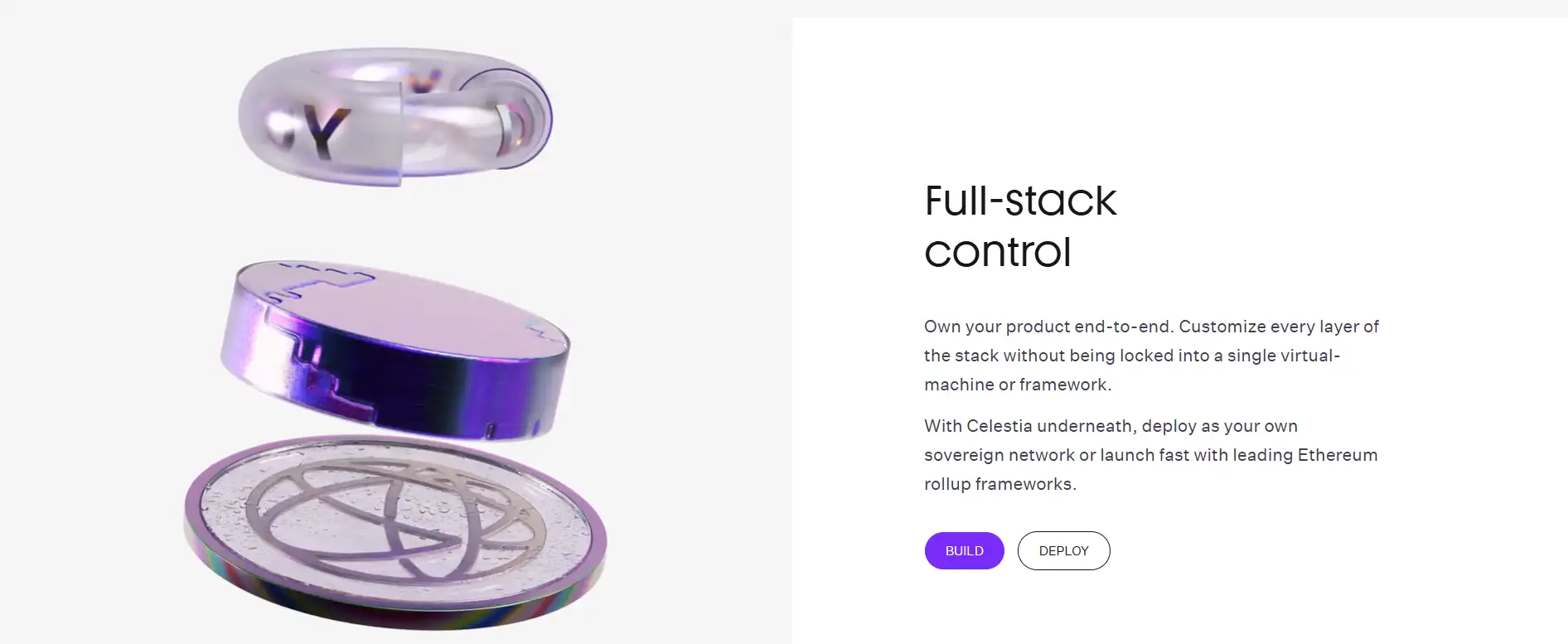
Celestia is a pioneering modular blockchain platform that revolutionizes how decentralized applications are built, deployed, and scaled. By separating consensus and execution layers, Celestia enables developers to launch their own blockchain with the ease of deploying a smart contract, eliminating the constraints of traditional monolithic blockchains.
The foundation of Celestia’s architecture lies in its data availability layer, which decouples data publishing from transaction execution, enabling scalable and verifiable block production. With Celestia underneath, applications like DeFi protocols, gaming platforms, communication layers, and stablecoin systems can operate independently as sovereign chains with full-stack customization.
Celestia introduces a paradigm shift in the blockchain landscape by enabling developers to deploy their own blockchain as easily as deploying a smart contract. Traditional blockchains operate as monolithic systems where consensus, execution, and data availability are bundled into one chain, creating scalability limitations. In contrast, Celestia offers a modular architecture where developers can select best-in-class components and deploy sovereign rollups or Layer 2 solutions that inherit Celestia’s secure and decentralized data availability.
At the core of this innovation is Data Availability Sampling (DAS), a technology that allows light nodes to verify massive blocks without downloading all the data. This breakthrough ensures that Celestia scales with the number of users, making it the first blockchain capable of expanding its throughput in tandem with user growth. DAS allows anyone to validate data availability securely, eliminating the need for trust in centralized validators or committees.
Celestia’s ecosystem is quickly growing, with projects like Converge (high-performance chain for RWAs and DeFi), Abstract (consumer crypto apps), Doma by D3 (domain tokenization), Towns (onchain communication), and Kamigotchi (onchain gaming) all choosing to build “with Celestia underneath.” These projects benefit from Celestia’s abundant data availability and modular design.
Other notable platforms in the modular blockchain or data availability space include Avail, EigenLayer, and Fuel. While each offers components for scalable blockchain applications, Celestia stands out by delivering a truly decentralized, scalable data availability layer with DAS at its core, making it a foundational piece for the next generation of onchain apps.
Celestia offers a robust set of features and benefits that empower developers to build high-performance, decentralized applications:
Getting started with Celestia is designed to be simple and developer-friendly:
Data Availability Sampling (DAS) is a breakthrough that allows Celestia to scale efficiently without sacrificing decentralization. Instead of downloading entire blocks, light nodes only need to sample small portions of data to verify its availability. This means that as more users (light nodes) join the network, Celestia's throughput actually increases, enabling support for massively scalable rollups and fully onchain applications.
Sovereign rollups on Celestia operate independently without relying on any settlement layer for security or execution. This gives developers full-stack control—freedom to choose their own virtual machines, governance models, and execution environments—unlike traditional Layer 2s that depend on Ethereum for settlement and consensus. This flexibility unlocks new design spaces and development autonomy.
Yes, Celestia is already powering high-throughput, real-world use cases. Projects like Kamigotchi are leveraging Celestia’s architecture for onchain gaming, while Towns is building the next-gen communication layer on top of it. Thanks to Celestia’s modular design and scalable data availability layer, it’s now possible to run applications that were previously limited by the constraints of traditional blockchains.
With Celestia underneath, developers can deploy a fully sovereign blockchain with as little friction as deploying a smart contract. They gain control over the virtual machine, gas fees, upgradeability, and user experience—without being affected by congestion or governance decisions on shared Layer 1s. This unlocks enterprise-grade performance and scalability with minimal overhead, perfect for custom apps and protocols.
To “build with Celestia underneath” means using Celestia as your data availability layer while retaining complete control over execution and consensus. Unlike many other modular chains that still rely on centralized committees or limited SDK options, Celestia offers truly decentralized data availability, scalable throughput via DAS, and unmatched flexibility through its Sovereign SDK and Rollups-as-a-Service integrations.